Last updated: November 18, 2026
Pet insurance is worth it for many owners who couldn’t comfortably pay a surprise vet bill of several thousand dollars. It’s usually not a money-maker: most years you’ll pay more in premiums than you get back. The value is in protection against the big, unexpected bill. Here’s how to decide for your dog or cat.
The short version
| Dog | Cat | |
|---|---|---|
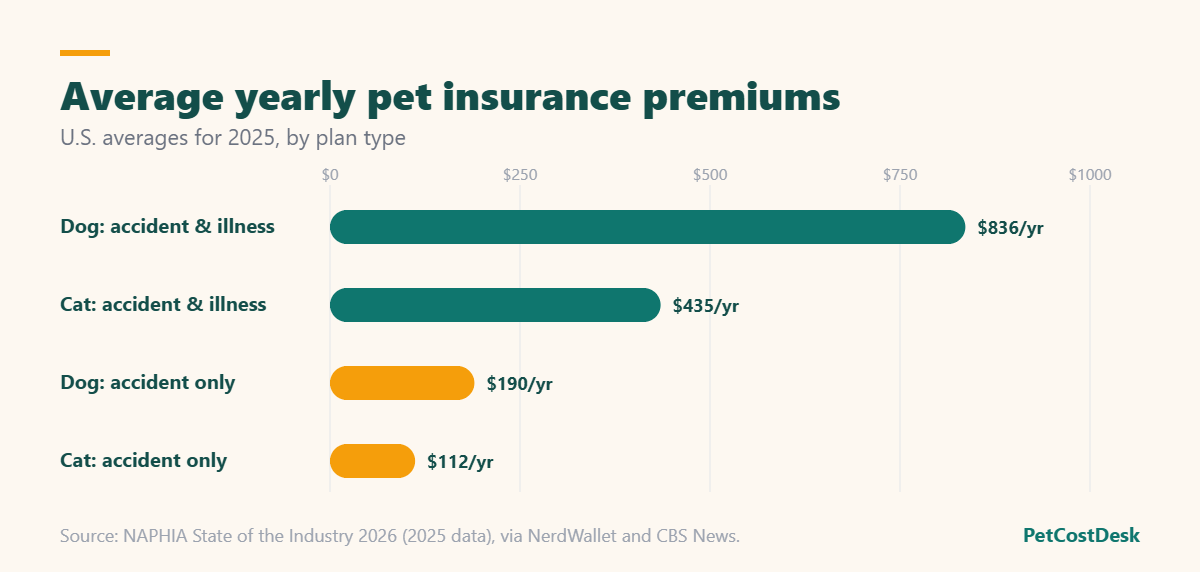
| Average accident & illness premium (2025) | $836 per year (about $70/month) | $435 per year (about $36/month) |
| Average accident-only premium (2025) | $190 per year | $112 per year |
| Usually covers | Accidents, illnesses, emergency care, surgery and diagnostics, after a waiting period | |
| Usually doesn’t cover | Pre-existing conditions and, unless you add a wellness plan, routine care | |
How pet insurance works
Most pet insurance reimburses you after you pay the vet. You choose three things that set your price:
- Deductible: what you pay each year (or per condition) before the policy pays.
- Reimbursement rate: the share of the eligible bill the insurer repays, commonly 70%, 80% or 90%.
- Annual limit: the most the policy pays in a year, from a few thousand dollars to unlimited.
A higher deductible and lower reimbursement mean a cheaper premium, but more out of pocket when something happens.
When pet insurance is usually worth it
- You couldn’t pay a $2,000 to $5,000 bill without debt. Emergency surgery or a hospital stay can reach that quickly.
- Your pet is young and healthy. Enrolling early means fewer conditions are excluded as pre-existing, and premiums start lower.
- Your breed is prone to costly problems. Some breeds are known for joint, heart or breathing issues that are expensive to treat.
- You’d want every treatment option. Insurance can make it easier to say yes to specialist care.
When it may not be worth it
- You already have a solid emergency fund for your pet and are comfortable paying large bills yourself.
- Your pet is older with several pre-existing conditions. Premiums are higher and those conditions won’t be covered.
- You mainly want help with routine costs. Standard policies don’t cover checkups and vaccines; wellness add-ons often cost about as much as the care they cover.
Insurance vs. saving on your own
An alternative is to put the premium amount into a dedicated savings account every month. That works well if nothing big happens early on, but a serious accident in the first year could cost far more than you’ve saved. Some owners combine both: a cheaper policy with a higher deductible, plus savings for routine care. For a sense of everyday vet prices, see how much a vet visit costs.
What to check before you buy
- Waiting periods for accidents, illnesses and specific conditions such as hip or knee problems
- How the policy defines and handles pre-existing conditions
- Whether exam fees, dental illness and prescription diets are covered
- How premiums rise as your pet gets older
- Annual limits and whether the deductible is yearly or per condition
Compare at least three quotes with the same deductible, reimbursement rate and limit, and read the sample policy before you sign up.
Key takeaways
- Accident and illness plans averaged $836 a year for dogs and $435 for cats in 2025.
- Insurance pays off when a large, unexpected bill would be hard to cover, not as a way to save on routine care.
- Enroll while your pet is young and healthy to avoid pre-existing condition exclusions.
- Compare quotes with the same deductible, reimbursement and limit, and read the exclusions.