
Last updated: November 19, 2026
Three numbers decide how much a pet insurance policy pays you back: the deductible, the reimbursement rate and the annual limit. Choosing them is a trade-off: a lower deductible and higher reimbursement mean bigger payouts but a higher monthly premium. Here’s how each works, with examples.
The short version
| Setting | What it does | Common choices |
|---|---|---|
| Deductible | The part of eligible bills you pay before coverage kicks in | $100–$1,000 |
| Reimbursement rate | The percentage of the rest that the insurer repays | 70%, 80% or 90% |
| Annual limit | The most the policy pays in a policy year | $5,000 to unlimited |
How the deductible works
Most policies use an annual deductible: once you’ve paid it, it’s done for the rest of the policy year. Some use a per-condition deductible, which you pay once for each new condition, even if it lasts several years. Annual deductibles are simpler to plan for; per-condition deductibles can work out well if one long-term illness is your main worry.
How the reimbursement rate works
After the deductible, the insurer pays its percentage of the eligible bill and you pay the rest. With 80% reimbursement, you pay 20%. Only eligible costs count, so excluded items such as pre-existing conditions or routine care aren’t reimbursed.
Worked examples
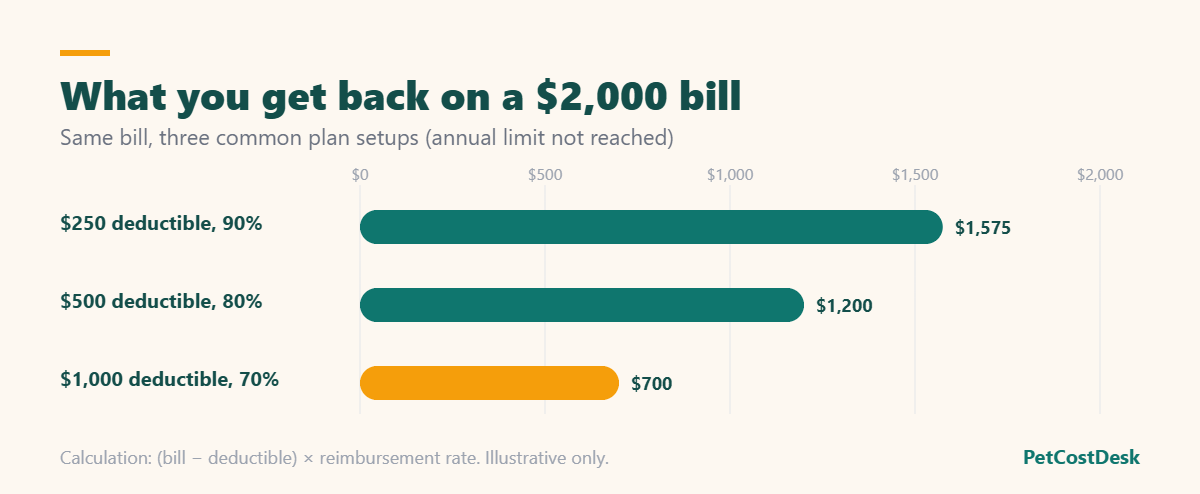
On a $2,000 eligible bill, the payout is the bill minus the deductible, multiplied by the reimbursement rate:
- $250 deductible and 90%: ($2,000 − $250) × 90% = $1,575 back
- $500 deductible and 80%: ($2,000 − $500) × 80% = $1,200 back
- $1,000 deductible and 70%: ($2,000 − $1,000) × 70% = $700 back
The first option pays the most but costs the most each month. The last is cheapest monthly but leaves you paying more when something happens.
How to choose
- Pick a deductible you could pay tomorrow without borrowing.
- 80% reimbursement is a common middle ground between premium and payout.
- Choose a limit that covers a major surgery, which can cost $3,500 to $8,000. See pet surgery costs.
- Compare quotes with identical settings so you’re comparing like with like.
For the basics, read how pet insurance works and how much pet insurance costs.
Key takeaways
- Your payout equals the eligible bill minus the deductible, times the reimbursement rate.
- Annual deductibles reset each year; per-condition deductibles apply once per condition.
- Lower deductibles and higher reimbursement raise your monthly premium.
- Choose settings you could afford on the day of a big bill, and compare quotes like for like.