Last updated: November 19, 2026
A pre-existing condition is a health problem your pet showed signs of, or was treated for, before coverage started or during the waiting period. Almost every pet insurance policy excludes them. Some insurers, though, will cover curable conditions again once your pet has been symptom-free for a set time, often 6 to 12 months.
The short version
| Type | Examples | Usually covered later? |
|---|---|---|
| Curable | Ear infections, urinary tract infections, some stomach upsets | Sometimes, after 6–12 months without symptoms or treatment |
| Incurable or chronic | Diabetes, allergies, many joint problems, cancer | Generally no |
| Knee and ligament problems | Cruciate ligament injuries | Often excluded or given special rules |
How insurers decide
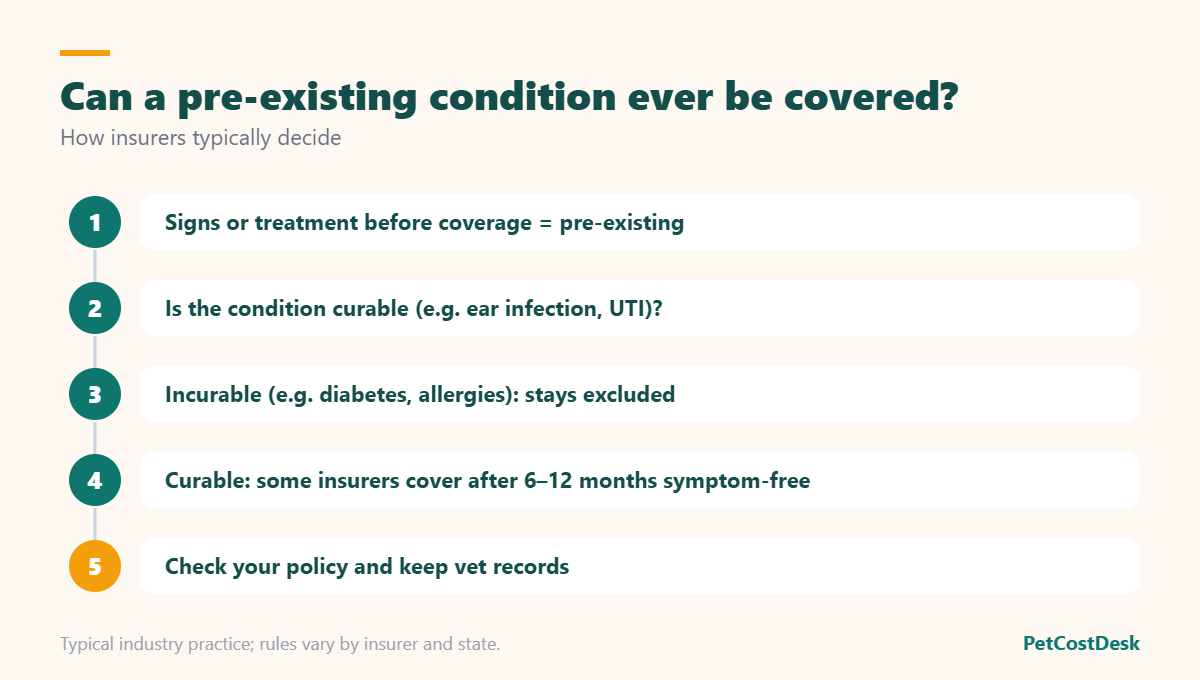
When you file a claim, the insurer reviews your pet’s medical records, especially from before your policy started. If a vet noted signs, gave advice or treated the condition before coverage began or during the waiting period, the insurer can treat it as pre-existing. Under the Pet Insurance Model Act adopted by the National Association of Insurance Commissioners, which states can choose to adopt, the burden is on the insurer to show that a pre-existing condition exclusion applies.
Curable vs. incurable
Insurers split pre-existing conditions into two groups. Incurable ones, such as diabetes or allergies, stay excluded. For curable ones, policies differ: ASPCA Pet Health Insurance, for example, says a curable condition is no longer pre-existing once it’s cured and free of symptoms and treatment for 180 days, while others such as Embrace and Figo use 12 months. Knee and ligament conditions often have their own stricter rules.
How to protect yourself
- Enroll while your pet is young and healthy, before conditions appear.
- Avoid gaps in coverage. Switching insurers can turn existing conditions into pre-existing ones under the new policy.
- Keep complete vet records and read your policy’s definition carefully.
- Ask before you buy how the insurer handles curable conditions and what counts as a symptom.
Learn the basics in how pet insurance works, and see pet insurance for older dogs and cats.
Key takeaways
- Pre-existing conditions are those with signs or treatment before coverage or during the waiting period.
- Incurable conditions like diabetes and allergies stay excluded.
- Some insurers cover curable conditions after 180 days to 12 months without symptoms.
- Enroll early and avoid coverage gaps to keep more conditions covered.